How to Prepare a Realistic Lok Sewa Study Timetable While Working Full-Time
Balancing Employment and Lok Sewa Preparation
Preparing for Lok Sewa Aayog examinations while holding a full-time job is challenging, but entirely achievable with structured time management. Most working aspirants fail not because they lack dedication, but because they design unsustainable schedules—such as trying to study six hours after an exhausting eight-hour workday. Success lies in consistent, high-yield sessions spread across mornings, commutes, and weekends.
1. Assess Your Fixed and Free Hours Accurately
Before writing a single study task, audit your 24 hours objectively:
- Fixed working hours: Office duties and mandatory professional tasks.
- Commuting time: Travel to and from work.
- Essential life routines: Sleep (aim for 6 to 7 hours), meals, exercise, and family commitments.
- Discretionary hours: The actual window you can allocate to preparation without burning out.
For most professionals, realistic weekday study time is between 2.5 and 4 hours. Acknowledging this limit prevents the guilt cycle of missing unrealistic targets.
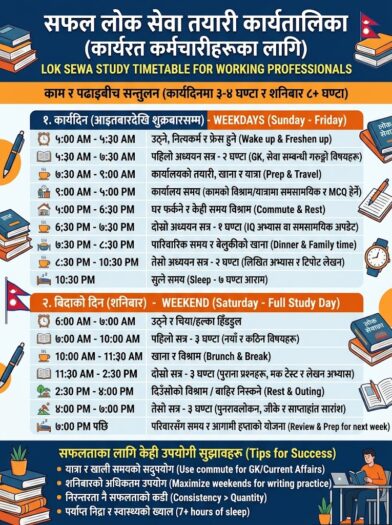
2. A Model Weekday Routine
Dividing your study time into focused slots before and after office hours keeps your cognitive load manageable.
The Morning Block (Early Morning: 5:30 AM – 7:30 AM)
Your mind is freshest before work stress intervenes. Use these two hours for demanding subjects:
- General Knowledge (GK) updates and daily national affairs.
- Core conceptual papers (Governance, Constitution, or contemporary issues).
- Note synthesis and analytical writing.
The Commute & Micro-Breaks (Throughout the Day)
Use short intervals during transit or lunch breaks for passive learning:
- Listening to recorded audio notes or reliable news discussions.
- Reviewing flashcards or mobile-friendly short summaries.
- Going through multiple-choice questions (MCQs) for GK or IQ.
The Evening Block (8:00 PM – 9:30 PM or 10:00 PM)
Avoid heavy analytical theory late in the evening when mental fatigue peaks. Instead, focus on:
- IQ practice problems (which involve active problem-solving rather than rote reading).
- Practicing one long-form written answer under timed conditions.
- Quick revision of the facts studied that morning.
3. Leveraging Weekends for Deep Work
Saturdays (and public holidays) are your leverage point. While your weekday output is around 3 hours, weekends offer a window for 6 to 8 hours of deep study divided into focused shifts:
- Morning Shift (3 hours): Full-length subject paper coverage and comprehensive reading.
- Afternoon Shift (2 hours): Past-paper analysis and structured answer-writing practice.
- Evening Shift (2 hours): Full syllabus revision, mock tests, and weekly progress assessment.
4. Practical Tips for Long-Term Consistency
Prioritize the Official Syllabus
Lok Sewa syllabi vary across services (such as Administration, Foreign Service, or Revenue) and levels (Officer, Nayab Subba, Kharidar). Always download the latest syllabus directly from the official Lok Sewa Aayog portal rather than relying on outdated compilations.
Build Revision into the Schedule
Information decays rapidly without reinforcement. Reserve the last 15 minutes of every daily session to review what you covered that day, and allocate Sunday mornings or Saturday afternoons strictly to reviewing the past week’s notes.
Set Weekly Milestones Instead of Hourly Quotas
Some workdays bring unexpected deadlines. If overtime reduces your evening study to 45 minutes, do not panic. Track your weekly target (e.g., 22 hours per week) rather than stressing over a single interrupted day.
Frequently asked questions
How many hours should a working professional study for Lok Sewa daily?
A realistic target for most working candidates is 2.5 to 4 hours on weekdays, supplemented by 6 to 8 hours on Saturdays or off-days.
Should I focus on Paper 1 (GK/IQ) or written subjective papers first?
Balance both simultaneously. Morning sessions can focus on GK/IQ or heavy theory, while evenings and weekends are ideal for essay writing and subjective paper practice.
Where can I get the official Lok Sewa syllabus and vacancy notices?
Always consult the official Lok Sewa Aayog website (psc.gov.np) and the weekly Gorkhapatra publication for verified syllabi, examination schedules, and vacancy announcements.